Sep 11, 2026Product Strategy
How to Develop a Skincare Line for a Clinic Without Overstating Claims
Plan a clinic skincare line by defining its home-care role, cosmetic claims, evidence, packaging, sample gates and manufacturing route.
Answer-First Summary
A clinic-associated skincare line should begin by separating the clinic service promise from the cosmetic product promise. Define what the product does in a consumer’s at-home routine, choose the target market, draft evidence-aligned cosmetic claims, decide the formula route, match the packaging to the use context, approve samples against written gates, and confirm the testing and order plan before production. A doctor’s name, a clinic channel or the phrase “professional use” does not turn an ordinary cosmetic into a treatment—or remove the need for truthful labeling and advertising.
BIO-TIDE can support this development path through an in-house R&D team, a library of 80,000+ mature formulas, or a One Client One Formula route. Its full-cycle coordination covers product planning, formulation, packaging, compliance coordination, testing, production and logistics. A typical starting reference is around 5,000 pieces, depending on the product and packaging scheme.
Start With the Boundary: Clinic Service vs. Home-Care Product
A clinic may have expertise in procedures, skin assessment and professional services. A consumer cosmetic sold under the same name has a different job. Its claims, instructions and evidence must describe the product itself—not borrow the expected outcome of a procedure.
Write two separate statements before asking for formulas:
Service promise: what the clinic’s professional service is intended to address, under the clinic’s own professional and regulatory responsibilities.
Product promise: what the at-home cosmetic is intended to do through normal consumer use, such as cleansing, moisturizing or improving the appearance and feel of skin.
If the product brief says only “post-treatment repair” or “medical-grade recovery,” the formulation team cannot tell whether the real goal is hydration, a low-fragrance sensory profile, support for dry-feeling skin, a specific dispensing format, or a therapeutic claim that changes the product category. Translate the service context into a precise cosmetic use case before formulation begins.
Why the Clinic Context Raises the Claims Standard
Clinic branding can change the net impression of otherwise familiar skincare language. Doctor imagery, white coats, treatment-room visuals and references to clinical practice may lead consumers to infer that a finished product is clinically proven or intended to treat a condition. The U.S. Federal Trade Commission advises marketers to assess both express and implied claims across the whole advertisement and to hold adequate substantiation before objective claims are disseminated.
The U.S. Food and Drug Administration also states that cosmetic labeling must be truthful and not misleading. Claims that a product treats or prevents disease, or affects the structure or function of the body, may make it a drug under U.S. law. This is why “treats acne,” “heals post-procedure skin,” “regenerates collagen” and “reduces inflammation” should not be treated as ordinary cosmetic copy.
The same planning discipline is useful beyond the United States, although the exact classification and wording rules vary by market. In the European Union, cosmetic claims—explicit or implicit—must be supported by adequate and verifiable evidence, and product performance should not go beyond the available support. Confirm the final formula, claims, artwork and documentation for the first target market before launch.
Do Not Use “Medical-Grade” as a Development Brief
“Medical-grade” may express the clinic’s desired positioning, but it does not define a formula. It gives no measurable target for texture, dispensing, tolerance preferences, evidence, market classification or consumer instructions. In the United States, FDA does not recognize “cosmeceutical” as a legal category; similarly, a premium or clinical-sounding label is not a substitute for determining what the product is and what claims it makes.
Replace vague authority language with development inputs: target consumer, home-care role, skin feel, fragrance policy, format, usage frequency, first market, sales channel, intended claims, evidence threshold, packaging, cost range and expected quantity.
Build the Clinic Product Brief in Nine Fields
Field | What to specify |
|---|---|
1. Consumer | Who will use the product at home? Define routine, preferences and relevant appearance or comfort concerns without diagnosing a condition. |
2. Home-care role | Cleanse, hydrate, improve the look of dryness, support a comfortable skin feel, or another clearly cosmetic role. |
3. Use context | Daily routine, seasonal use, or a clinic-recommended home-care step. State what other products may be used alongside it. |
4. First market | Name the first country or region. Classification, ingredient review, labels and acceptable claims depend on it. |
5. Intended claims | Draft the exact consumer-facing sentences—not only ingredient names or broad benefits. |
6. Sensory target | Absorption, residue, finish, fragrance, color and layering expectations. |
7. Packaging | Format, dose, hygiene, light/air exposure, label space and expected use environment. |
8. Commercial frame | Target retail position, acceptable cost range, initial quantity and number of SKUs. |
9. Approval gates | Who approves the formula, claims, artwork, packaging and production specification, and what evidence is required at each gate. |
Choose One Clear Home-Care Role
A clinic line becomes harder to develop when every product is asked to moisturize, brighten, calm, lift, repair, regenerate and protect at the same time. Select one primary product role and a small set of compatible supporting attributes.
For example, a lightweight daily serum might have a primary role of hydration, with supporting goals of a non-sticky finish and comfortable layering under sunscreen or makeup. That is more actionable than “professional anti-aging recovery serum.” The first description guides formulation and sampling; the second mainly signals positioning.
A focused role also makes the evidence plan more efficient. The team can decide which outcomes are consumer-perception goals, which require instrument data or other support, and which claims should be removed or escalated for regulatory review.
Use a Claims Ladder Before You Lock the Formula
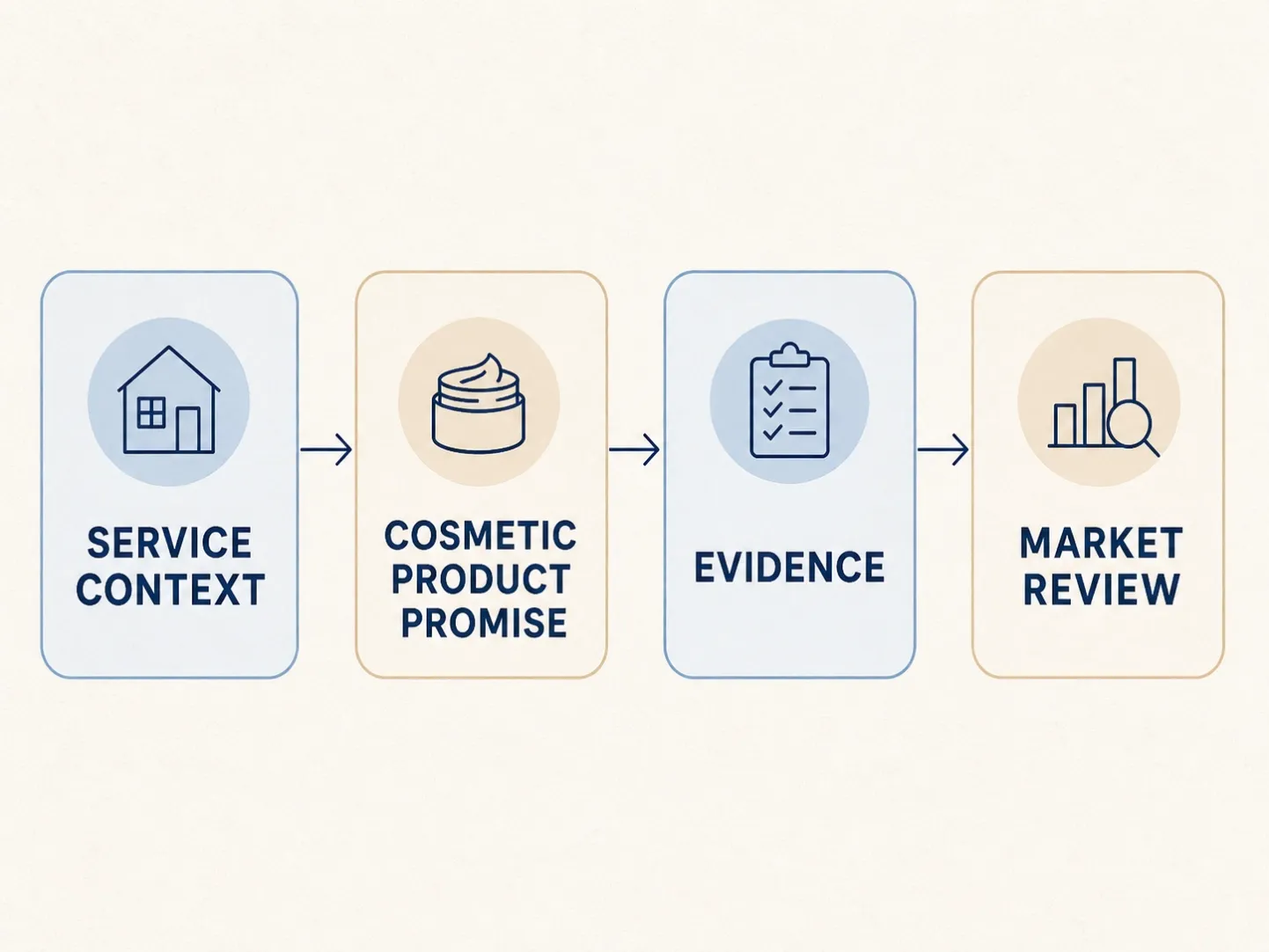
Create a claims ladder with three levels: the exact claim, the evidence needed for the finished product, and the decision owner. Ingredient literature may help explain why an ingredient was considered, but it does not automatically prove that the final formula delivers the same benefit. EU claim criteria expressly warn against implying that a finished product has an ingredient’s properties when the product evidence does not support that inference.
Product goal | Cosmetic draft for evidence review | Stop and classify/review |
|---|---|---|
Hydration | Helps hydrate skin and reduce the look of dryness | Heals post-procedure skin |
Appearance | Skin looks smoother with regular use | Regenerates skin cells or collagen |
Comfort | Helps soothe the feeling of dryness | Reduces inflammation or burning |
Blemish-prone routine | Cleanses excess surface oil | Treats acne |
Tone appearance | Improves the appearance of dull or uneven-looking skin | Inhibits melanin |
These examples are drafting distinctions, not automatic approvals. The final wording must fit the finished product’s evidence and the laws, language and consumer understanding of the target market.
Map Evidence to the Finished Product
A practical evidence map separates four different questions:
Formula and ingredient rationale: why the selected system fits the brief.
Safety and quality testing: what is needed for the formula, packaging and intended use.
Claim support: what supports each explicit and reasonably implied benefit statement for the finished product.
Consumer communication: whether the final name, visuals, directions and clinic context create an implied promise beyond the written claim.
The evidence should be relevant to the exact formula and benefit claimed. A clinic founder should ask for a claim-by-claim evidence table before artwork approval, not a general folder of ingredient studies after launch copy has already been written.
Treat Professional and Consumer Channels as Separate Use Cases
Decide whether the product is used by clinic staff, sold to consumers for home use, or both. Each use case needs clear instructions, packaging and channel assumptions. A treatment-room back-bar product may need controlled dosing and workflow compatibility; a retail home-care product needs consumer-readable directions and sufficient label space.
Do not assume that adding “for professional use only” removes ordinary retail obligations. FDA’s U.S. labeling guidance states that if a cosmetic is sold at retail to consumers, the ingredient declaration is still required even when the product bears professional-use wording. The point is broader than one label rule: channel language cannot repair a mismatch between the actual sales model and the product’s regulatory presentation.
Design Packaging for Dosing, Hygiene and Explanation
Clinic-associated products are often recommended during a short consultation. The packaging must make the routine easy to explain and repeat at home. Review:
Dose control: can the consumer dispense a consistent amount?
Contamination risk: is the opening appropriate for the product and use environment?
Formula compatibility: can the material and dispensing system protect and deliver the formula through its intended life?
Label space: can required information, directions and warnings be displayed clearly?
Routine clarity: can staff explain when and how to use the product without implying that it replaces medical care?
Accessibility: are type size, contrast and opening force appropriate for the intended consumer?
Confirm the intended package early enough for compatibility and dispensing evaluation. A formula that performs well in a laboratory jar may behave differently in an airless pump, dropper or fine-mist system.
Choose the Formula Route Around the Brief
A mature formula route can be efficient when a suitable system already matches the product role, sensory target, packaging and market requirements. A dedicated development route is more appropriate when the brief requires a distinct formula architecture, sensory profile or brand-owned direction that cannot be achieved through an existing option.
BIO-TIDE maintains a library of 80,000+ mature formulas and also offers a One Client One Formula route through its in-house R&D team. The right route should be selected after the clinic brief is defined—not from the assumption that “custom” is always better or that a mature formula is automatically ready for every claim and market.
Approve Samples With Written Gates
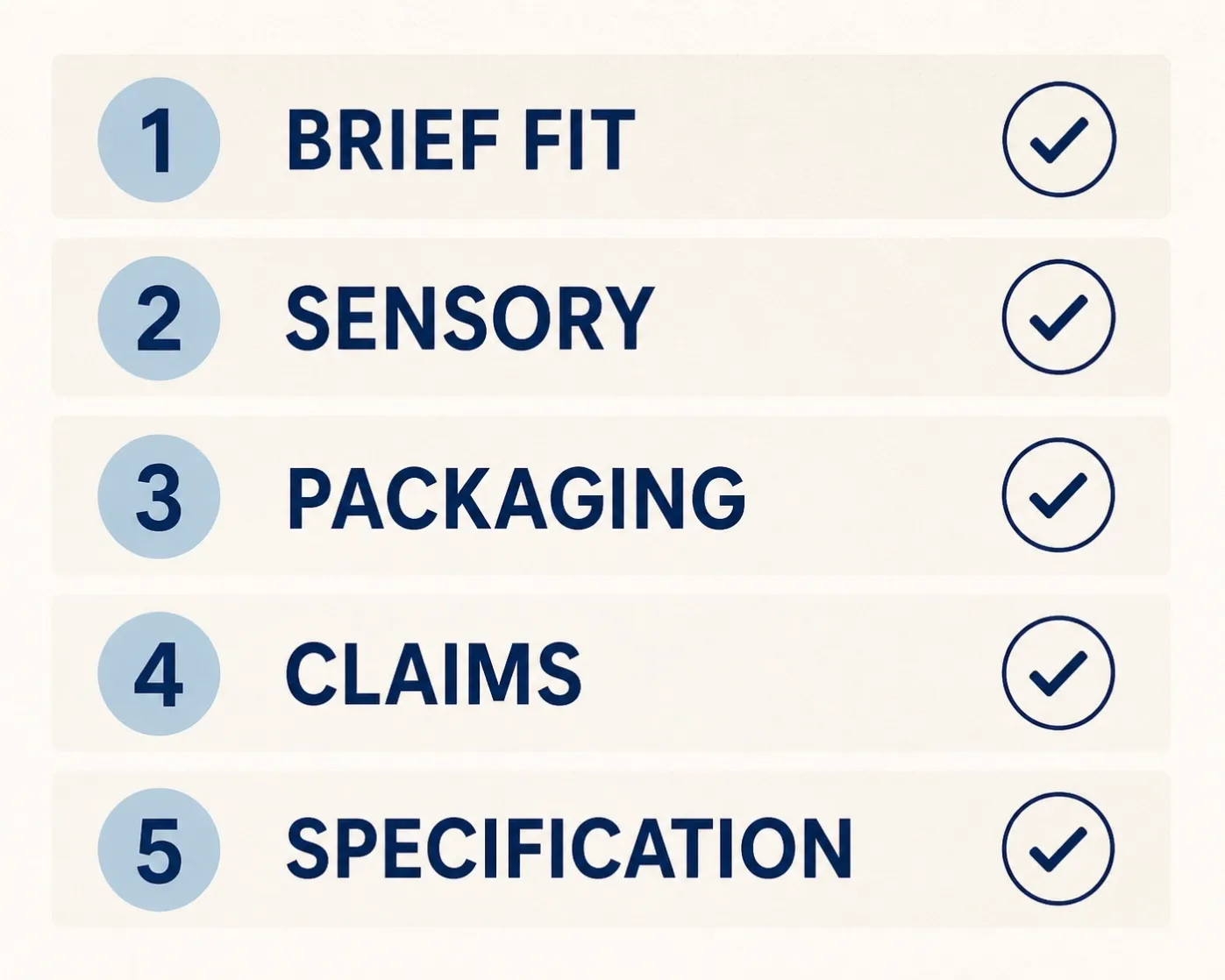
A clinic founder may evaluate a sample through personal preference, practitioner experience and feedback from colleagues. Those inputs are useful, but approval should still follow written gates so enthusiasm does not replace project control.
Approval gate | Decision question |
|---|---|
Gate 1 — Brief fit | Does the sample perform the defined home-care role and suit the intended user experience? |
Gate 2 — Sensory | Are absorption, residue, fragrance, color, finish and layering acceptable under the planned conditions? |
Gate 3 — Packaging | Does the selected dispenser deliver the intended dose without leakage, clogging or unacceptable product change? |
Gate 4 — Claims | Can every proposed statement be supported for the finished product and target market? |
Gate 5 — Specification | Are the approved formula, packaging, artwork and testing plan documented before production authorization? |
Plan Quantity After Formula and Packaging Are Connected
Do not treat minimum order quantity as a single number detached from the product. Formula batch size, filling, stock or custom packaging, decoration, cartons and testing can each create a different minimum. BIO-TIDE’s typical starting reference is around 5,000 finished pieces, but the actual quantity depends on the product and packaging scheme.
For a clinic line, inventory risk can rise quickly when volume is split across too many products or sizes. Start with the smallest coherent home-care concept that can be explained clearly and reordered realistically. Confirm the complete bill of materials before treating any quantity as final.
A Practical Development Workflow
Define the clinic-associated consumer, first market, sales channel and home-care role.
Separate service claims from finished-product cosmetic claims.
Prepare the nine-field product brief and claims ladder.
Select a mature formula direction or One Client One Formula route.
Review samples against sensory, use-context and packaging criteria.
Define the project-specific testing and claim-support plan.
Confirm packaging compatibility, directions, artwork and market-specific compliance inputs.
Approve the final specification, order quantity and production plan.
Coordinate manufacturing, quality documentation and logistics under the agreed scope.
BIO-TIDE coordinates this full development chain from product planning through formulation, packaging, compliance coordination, testing, production and logistics. Compliance coordination is not a promise of regulatory approval; final requirements and filings should be confirmed for the target market and responsible party.
Red Flags Before You Approve the Project
The brief depends on “medical-grade,” “doctor-developed” or “clinical” language but contains no precise product role or evidence plan.
Procedure outcomes are copied into retail product claims.
Ingredient studies are presented as proof of the finished formula without a relevance review.
Doctor imagery or clinic authority implies clinical proof that the evidence package does not support.
“Professional use only” is used to avoid planning for actual consumer retail use.
Artwork is finalized before claims, directions, label space and first-market requirements are reviewed.
A fixed MOQ is accepted before packaging and decoration minimums are confirmed.
Questions to Send a Manufacturer
Which formula route best fits this exact home-care role, market, packaging and claim plan?
Which claims need finished-product evidence, and what testing route is appropriate?
How will the intended dispenser be evaluated with the formula?
Which decisions must be frozen before testing, artwork and production?
What is the binding minimum across formula, filling, packaging, decoration and cartons?
Which compliance activities are coordinated by the manufacturer, and which remain with the brand or local responsible party?
How BIO-TIDE Can Support a Clinic Home-Care Line
BIO-TIDE supports skincare product development with an in-house R&D team, an 80,000+ mature formula library and a One Client One Formula option. The project path can cover product planning, formulation, packaging, compliance coordination, testing, production and logistics.
The starting point is not a treatment claim or a list of fashionable ingredients. It is a clear description of the consumer, home-care role, first market, sensory target, packaging, intended claims and commercial frame. BIO-TIDE’s typical starting reference is around 5,000 pieces, depending on the product and packaging scheme.
Send BIO-TIDE your target consumer, first market, clinic-to-home routine, product role, intended claims, preferred packaging, budget range and expected quantity. The team can then map a relevant formula, sampling and production route.
Frequently Asked Questions
Can a clinic sell its own skincare line?
A clinic can develop a branded line, but the exact business, product, labeling and professional-practice requirements depend on the target market and sales model. Define whether each item is a cosmetic, drug, device or another category before launch, and obtain market-specific review.
Does a doctor’s name make a skincare product medical-grade?
No label or endorsement replaces product classification, evidence and compliant claims. In the United States, FDA does not recognize “cosmeceutical” as a legal category. A clinic should define the product’s actual intended use and support both express and implied claims.
Can a clinic skincare product claim to heal skin after a procedure?
That wording may imply treatment or a structure/function effect and requires classification and regulatory review. For a cosmetic brief, define the intended at-home role—such as hydration or improving the look of dryness—and align the final claim with evidence and target-market rules.
Is “for professional use only” enough for a clinic product?
No. The statement must match the real sales and use model. FDA states that a cosmetic sold at retail to consumers still needs an ingredient declaration even when it is labeled for professional use only.
Should a clinic choose a mature formula or custom development?
Choose according to the brief. A mature formula may fit a clear role and sensory target efficiently; a dedicated route may be appropriate when the concept needs a distinct formula direction. Both routes still require packaging, evidence and market review.
What is BIO-TIDE’s minimum order quantity?
BIO-TIDE’s typical starting reference is around 5,000 finished pieces. The actual quantity depends on the formula, filling, packaging, decoration and product configuration.
What should a clinic send before requesting samples?
Send the target consumer, first market, home-care role, intended claims, sensory target, fragrance policy, packaging direction, cost range, expected quantity and decision timeline.