Mexico is Latin America's second pet market: pet care is forecast at $8.49 billion by 2034, premium formulas are taking share, and the shelf still lacks local supply. This guide covers the size, the buyer, the channels, the listing file, and the window.
How big is Mexico's pet grooming market, really?
Mexico's pet care market grew from $5.66 billion in 2025 to $5.99 billion in 2026, and IMARC forecasts $8.49 billion by 2034, a 4.47% compound annual rate. The grooming slice inside it — pet care products — is growing faster, from $3.0 billion in 2025 to $5.2 billion by 2034 at 6.07% a year.
This article is for a brand or retailer planning a Mexico grooming line in 2027: it tells you where the demand sits, what the shelf is missing, and what file you need before you discuss price. It does not promise a listing timeline, because that decision belongs to the retailer and the regulator, not to a supplier.
Start with the two numbers that frame the market. IMARC puts Mexico pet care at $5.99 billion in 2026, on its way to $8.49 billion by 2034. Euromonitor, measuring retail sales, puts 2026 at MXN 93.5 billion, up 8% on the previous year — growth driven by value, not volume, which is what premiumisation looks like in the data.
Pet products alone are set at MXN 12.4 billion in 2026, up 11%. The regional picture puts Mexico in second place. Latin America's pet care market is forecast at $18.88 billion by 2033 (IMARC, 5.79% CAGR), and Mexico holds about a fifth to a quarter of regional demand (IndexBox, August 2026).
Brazil holds 40–45%; together the two countries are more than 70% of the region. A brand that wins Mexico has a base to serve the rest of the region from, and a brand that skips Mexico is skipping a fifth of the market.
The growth is not evenly spread. Dog grooming is the volume engine: dogs held 67.84% of Mexico's pet care products revenue in 2025 (Data Bridge). Cats are the fastest-growing pet type, at a 6.7% annual rate to 2033, as urban living and smaller homes favour cats.
A grooming line that only serves dogs is serving the present; a line that also serves cats is serving the direction of travel.
Who is buying premium grooming in Mexico?
Nearly 70% of Mexican households owned a pet as of 2021, and nearly 80% of the population lives in urban areas (IMARC). The buyer is an urban pet owner who treats the animal as a family member and is willing to pay for health and wellness — but the spending is split.
About 45% of owners spend less than $60 a month on pet care, while only 3% spend more than $160. That split is the market's shape, not a contradiction. The budget half buys on price and buys private label; the premium minority buys on health, ingredients and proof.
Euromonitor's 2026 summary for Mexico is explicit: premiumisation and private label are reshaping consumer choices at the same time, and the two trends feed each other — budget families switch to store brands, affluent owners switch to premium health grooming.
For a grooming brand, the implication is precise. The middle of the shelf is crowded with imported mass brands. The two open spaces are a credible premium line with evidence behind its claims, and a private-label line a retailer can sell as its own.
Both need the same thing from a manufacturer: a formula with a file, not a formula with adjectives.
Where do Mexican pet owners actually buy grooming?
The channel shift is the second half of the story. IMARC lists digital e-commerce expansion as the leading Mexico trend: online retail is growing on rising internet and mobile adoption, better logistics beyond the major cities, and in-app grooming bookings.
Modern retail and specialty pet stores are growing with it, and the two channels now reinforce each other — owners discover online and buy in store, or the reverse.
Private label is the channel story that matters most for a manufacturer. Euromonitor's Mexico summary notes private-label expansion alongside premiumisation, and warns that it will be challenged by quality demands as the market matures. Retailers want own-brand grooming, but only if the quality holds.
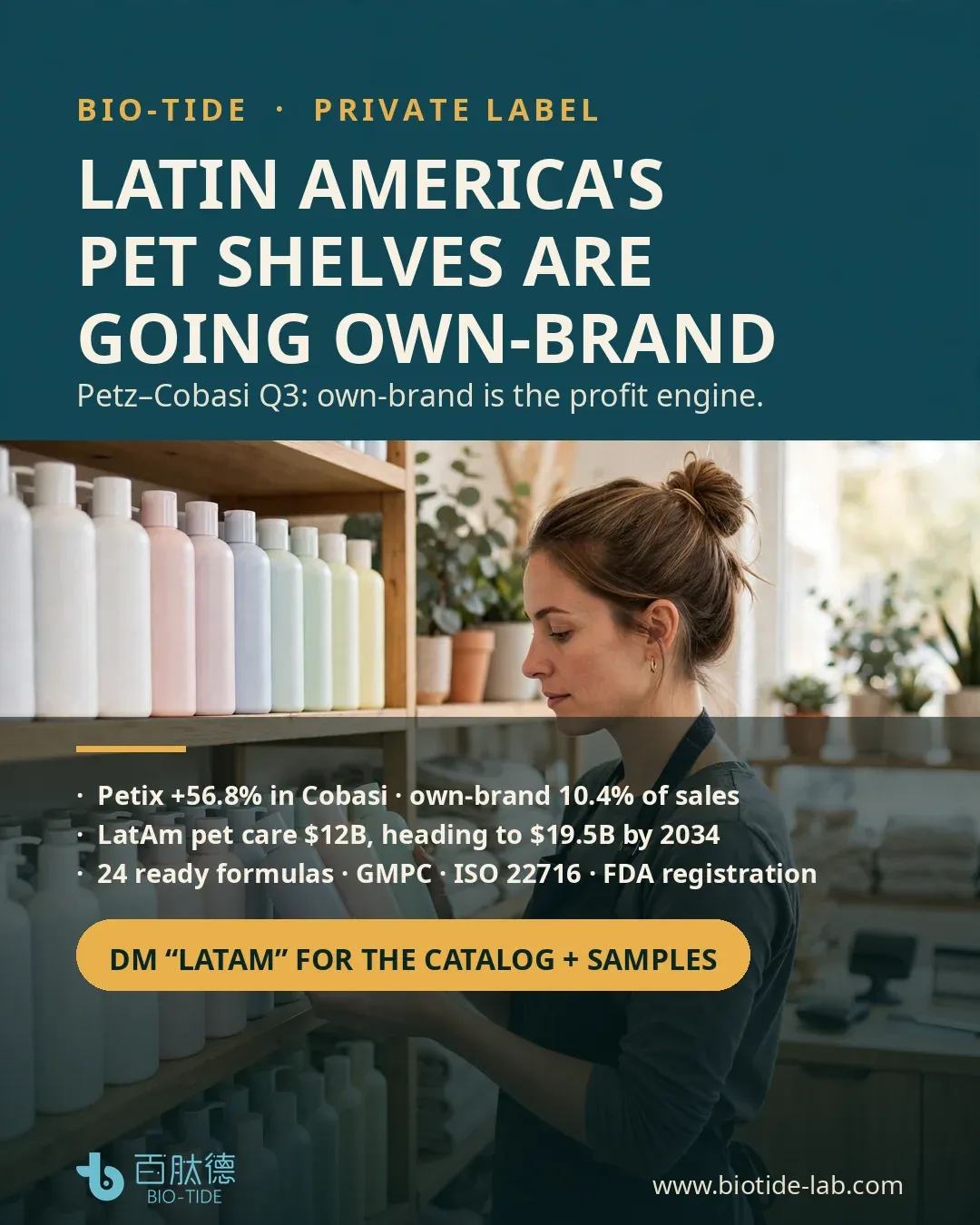
The regional signal is loud: in Brazil, the largest retailer Grupo Petz Cobasi reported own-brand sales up 15.2% at Petz and 56.8% at Cobasi in the third quarter of 2026, and said unified supplier talks and own-brand cross-selling were the main profit driver. Mexico's retailers are watching the same playbook.
A brand entering Mexico should therefore plan for two doors at once: the modern retail shelf, where a premium line competes on evidence, and the retailer's own brand, where a manufacturer competes on formula, file and delivery. The second door is the larger opportunity, and it is the one a factory can open.
What does it take to list a grooming line in Mexico?
Mexico's regulator, COFEPRIS, is raising the evidence bar for efficacy claims — the same direction as Brazil's ANVISA. No literature or trial data behind the claim, no listing. The evidence is a file, not a sentence.
A buyer will ask for five documents before discussing price: the formula file, the ingredient list, the test reports, the certification, and the claim language agreed in writing.
Our position is simple, and it is the same one we take everywhere: we make no therapeutic claims. We make skincare-grade pet grooming — 24 ready formulas across shampoo, mousse and spray — and with every formula we provide the file, so your team can support its own registration under its own brand.
GMPC and ISO 22716 certified, FDA registered. Samples first, MOQ from 1,000 units. Made by the manufacturer behind MUSENTANG.
The practical consequence is a sequence, not a negotiation. Send the line and the volumes, confirm the samples, agree the claim language in writing, and then discuss the price. A supplier who discusses price before the file is asking the buyer to carry a risk the buyer cannot carry.
Why Mexico, and why now?
Three facts make the timing specific. First, Mexico was investigated under the US Section 301 process but is not in the final 14 economies published on 25 November — no determination, no proposed tariff. A brand building a Latin America line removes one risk from the plan by starting in Mexico.
Second, the USMCA remains in force, and more than 80% of Mexico's exports to the United States are still duty-free. Third, the US–China truce runs to 10 January 2027, and the Section 301 written comments are due 5 January 2027, with public hearings from 25 January.
The window is the weeks before the hearings, not after. A quote written now rests on today's terms, at its normal validity — but only if the validity and the tariff clause are in writing. That is the discipline this market rewards.
Lock the specification against an approved sample, confirm the sample the way the bulk will be stored, and ask for the quote's validity date in writing. None of this is a promise that tariffs will fall. It is a window in which the terms are known.
A brand that waits for the hearings to conclude will be quoting on whatever they decide.
What should a brand send first?
Start with three formats, not thirty. A shampoo, a mousse and a spray cover the daily routine, the quick clean and the leave-in care — and three formulas are enough to test the shelf before committing to a range.
MOQ is from 1,000 units per item, so a three-format launch is a real test, not a warehouse bet. Send your line specs and volumes, and we will quote item by item, with the validity in writing. We reply within one hour.
Samples come first: confirm the texture, the scent and the file before the bulk is made. If Mexico is on your 2027 plan, the first step is a sample, not a slide deck — and the second step is the file that gets the line listed.