
Oct 7, 2026Manufacturing & Quality
Cosmetic Net Content Verification: Tare, Density, and Fill Checks
Learn how skincare brands and manufacturers should align tare, density, sampling, fill checks and escalation rules before production starts.

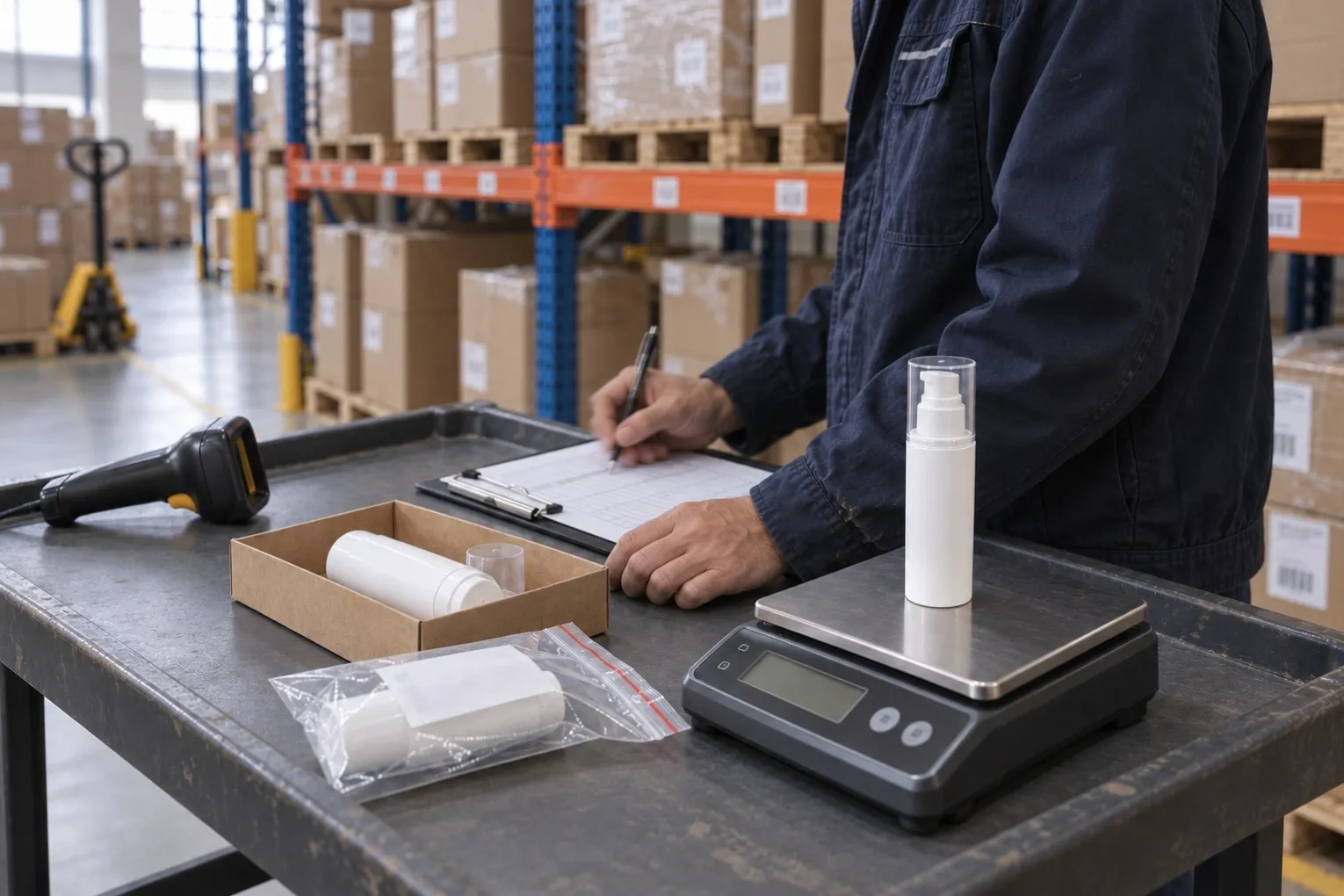
A net-content check is reliable only when the measurement method is agreed in advance. Before filling starts, the brand and manufacturer should align the declared quantity, test route, empty-pack tare, product density where volume is involved, sampling timing, acceptance rule and response to a failed result.
This is narrower than a complete cosmetic filling-line control plan. It answers one practical question: how will both parties decide whether a filled pack contains the quantity it is meant to contain?
Start with the label declaration and target market
First confirm what the pack will declare: mass, volume or another permitted quantity. Then confirm the destination market. A factory method cannot be chosen only because it is convenient or was used for another customer.
The OIML R 87:2016 recommendation separates nominal quantity, actual quantity and packing material. It also sets legal-metrology principles for prepackages. In the United States, NIST Handbook 133 is the current procedural reference for checking packaged-goods net contents.
These documents are compliance references, not a ready-made process sheet for every skincare line. OIML itself notes that its official sampling plans are not recommended as a packer's process-control plan. The brand still needs to confirm the applicable local rule and then agree an internal control method that can detect drift before release.
Choose the measurement route before production
For a product declared by mass, the basic route is often gravimetric: weigh the filled unit and subtract an approved tare. For a product declared by volume, the manufacturer may use a direct volumetric method or a mass-to-volume conversion supported by a controlled density value. The correct route depends on the declaration, product behavior, pack and applicable market rule.
Do not switch routes after a result looks inconvenient. Record the method in the product specification or filling instruction before the batch begins. The skincare product specification sheet should identify the unit, equipment, sample condition and decision rule.
Method input | Why it can change the result | What to agree |
|---|---|---|
Declared quantity | Mass and volume are not interchangeable | Unit and target-market rule |
Empty-pack tare | Bottles, pumps, caps and decoration vary | Pack set, tare sample and update trigger |
Product density | Temperature and entrained air can affect conversion | Method, temperature and timing |
Balance or device | Capacity and resolution affect usable readings | Equipment ID and check status |
Sample condition | Cooling, settling and wiping can change the measured unit | When and how the unit is tested |
Control tare as a real production variable
Tare is not just one number copied from a packaging drawing. A complete tare may include the bottle or jar, pump or closure, liner, label, decoration and any part included in the finished pack but not in the product quantity.
The team should decide whether it will use individual tare, an average tare or another justified approach. It should also define how many empty packs establish the tare and when the value must be refreshed. A packaging lot change, decoration change, component substitution or visible weight shift should trigger review.
If tare variation is large compared with the allowed product variation, subtracting one old average can hide underfill or create false failures. In that case, the pack variation must be addressed in the method rather than ignored at release.
Use density carefully for volume claims
When a volume declaration is checked through mass, density becomes part of the decision. The value should come from the finished bulk under defined conditions, not from water and not from an early lab assumption.
Agree the density method, sample temperature, deaeration or rest condition and test timing. A thick emulsion with entrained air may give a misleading conversion if density is measured immediately after high-shear mixing. A very fluid product may need a different sampling technique to avoid loss during transfer.
The goal is traceability: another trained person should be able to use the same bulk, method and conditions and reach a comparable result.
Define sampling points that can catch drift
One passing unit does not prove the run is stable. Sampling should cover meaningful stages such as line start, after adjustment, during the run, after a component refill and near the end. The frequency should reflect line speed, filler behavior, pack format and the risk of losing control between checks.
The production record should connect each sample to the batch, line, time and filling head where relevant. If a filler has several nozzles or pumps, the plan should be able to reveal a head-specific problem instead of averaging it away.
Keep regulatory compliance sampling separate from routine factory monitoring. The first asks whether a defined lot meets an applicable rule. The second helps the factory detect drift early enough to correct the process. They can support each other, but they do not have the same purpose.
Agree the response before a result fails
A useful plan states what happens after an out-of-limit result. At minimum, define:
- when the line is paused;
- which units or time window are placed on hold;
- whether and how the measurement is repeated;
- how the balance, tare and density inputs are checked;
- who can adjust the filler;
- how affected units are segregated or reworked;
- what evidence is needed before the line resumes; and
- what enters the final batch record.
Avoid automatic retesting until a passing number appears. A retest should answer a documented question, such as a suspected measurement error or a verified equipment issue. It should not erase the first result.
Buyer checklist before filling approval
Before approving commercial filling, ask the manufacturer to confirm:
- the declared net quantity and target market;
- the measurement route and unit;
- the exact empty-pack set included in tare;
- the density method if mass is converted to volume;
- the equipment and verification status;
- the sample condition and timing;
- the start, middle, change-point and end checks;
- the acceptance, hold, retest and escalation rules; and
- where results appear in the batch and release records.
This information should connect to the wider cosmetic batch release checklist. A certificate or final summary is easier to interpret when the underlying method was agreed before production.
Frequently asked questions
Is fill weight the same as net content?
Not always. A gross filled-pack weight includes the packaging. Net product mass normally requires tare subtraction. A volume declaration may also require a controlled density conversion or another approved method.
Can the nominal label quantity be used as the filling-machine target?
The label quantity is the consumer declaration, not automatically the machine setting. The operating target needs enough process margin to control variation while avoiding unnecessary overfill. The manufacturer should set and justify it using line capability, the test method and the applicable rule.
Should every unit be weighed?
Not in every process. Some lines use automated checkweighing, while others use defined in-process samples. The right plan depends on risk, line design, pack variation and the applicable market requirement.
When should tare be reviewed?
Review it when the packaging lot or component set changes, when decoration changes, when an approved supplier or specification changes, or when empty-pack checks show a meaningful shift.
Need a clearer net-content control plan?
BIO-TIDE can help structure the brand-manufacturer discussion around:
- label quantity and target market;
- tare and density method;
- sampling and check timing; and
- hold, retest and release rules.