Sep 11, 2026Formulation & Testing
How to Define a Skincare Sensory Profile Before Formula Development
Learn how skincare brands can define texture, rub-in and after-feel targets before formulation, then evaluate samples with a practical sensory scorecard.

“Lightweight,” “silky” and “luxurious” sound clear in a meeting. They are not clear enough for a formulator. One person may call a rich cream silky, while another uses the same word for a fast-drying gel. A skincare sensory profile turns those loose ideas into observable product behavior.
For a growing skincare brand, this profile should be agreed before formula development begins. It gives the brand, laboratory and sample reviewers one shared target for appearance, pickup, rub-in and after-feel. It also makes sample feedback faster and more useful.
Why define the sensory profile before formulation?
Sensory performance shapes how a product fits its user and routine. A sunscreen used under makeup has a different job from a night cream used as the last step. A body lotion for a humid market may need a different finish from one designed for dry, cold weather.
An early sensory target helps the development team choose a starting direction and avoid random sample rounds. It should sit beside the audience, use case, claims direction, package and market requirements in the skincare product brief.
Step 1: Start with the user, routine and market
Do not begin with texture words. Begin with the moment of use. Define who applies the product, where it sits in the routine, what may be layered before or after it, and what the user needs to do next. Then state the climate, sales channel and pack format.
Name the target user and the skin concern the product is designed to support.
State whether the product is used in the morning, evening or throughout the day.
List the products that may be layered with it, including sunscreen or makeup.
Describe the target climate and the expected use environment.
Confirm the dosage form and dispensing format being considered.
These facts give sensory words a purpose. “Fast rub-in” becomes meaningful when the user must dress soon after applying a body lotion. “Cushioning” becomes useful when the product is meant to be the final evening step.
Step 2: Describe the full application sequence
A sensory profile is not one texture word. Review the product in stages: before use, during application and after application. This prevents a pleasing first touch from hiding a finish that does not fit the routine.
Evaluation phase | Useful descriptors | Question for reviewers |
|---|---|---|
Appearance and pickup | Glossy or matte; dense or fluid; holds shape or levels; easy or resistant to pick up | What does the product communicate before it reaches the skin? |
Initial spread | Quick or controlled spread; light or rich; immediate slip; cooling or neutral | How does the sample behave in the first few strokes? |
Rub-in | Short or long rub-in; drag; cushion; play time; visible whitening during application | How much work is needed to distribute the product evenly? |
Immediate after-feel | Dry, powdery, waxy, oily, soft, tacky or coated | What remains when rubbing stops? |
Settled finish | Comfort, residue, shine, tack, softness and layering behavior after a set time | Does the finish still fit the routine after the product settles? |
Choose a small set of terms that matter to the concept. Too many descriptors create noise. The goal is a practical decision tool, not a dictionary.
Step 3: Separate intensity from preference
Reviewers often mix two different questions: “How much tack do I feel?” and “Do I like it?” Record them separately. Intensity describes the product. Preference records the reviewer’s response.
A low, medium and high scale can be enough for early development if every point has a short definition. For example, medium tack might mean that fingertips meet slight resistance but separate cleanly. Add a separate fit decision such as on target, acceptable or off target.
Use the same scale for every sample in the round.
Define the end points in plain language.
Record what was observed before discussing preference.
Link each preference to the target user and use case.
Do not average away a clear problem with one critical attribute.
Step 4: Use references as anchors, not copy targets
Reference products help reviewers calibrate language. Select one or two examples for a specific property, such as pickup, spread or finish. Do not ask a development partner to copy an entire competitor formula or claim that the reference proves identical performance is possible.
State exactly what the team should learn from each reference: “similar speed of rub-in, but less shine” is more useful than “make it like this.” Keep the package, formula age and application amount in mind because they can change the experience.
Step 5: Control how samples are evaluated
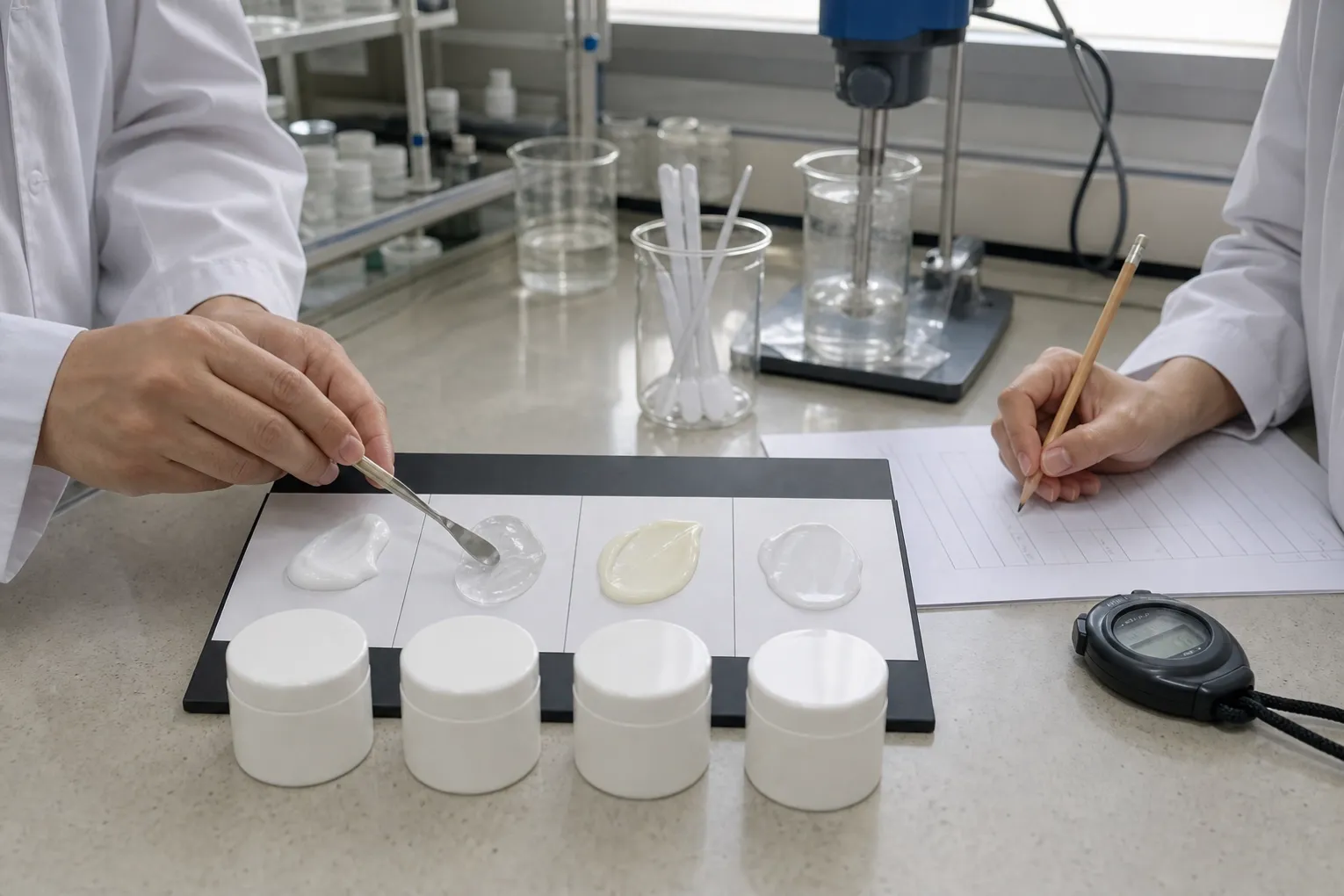
A simple evaluation protocol makes feedback more comparable. Use the same application site, approximate amount, rub-in method, review timing and sample order. Let reviewers work independently before a group discussion so the strongest voice does not set the score for everyone else.
General sensory-analysis methods also emphasize controlled procedures and clear terminology. Teams that need a formal framework can consult ISO 6658 general guidance on sensory analysis methodology and adapt the principles to the product, panel and development stage.
Step 6: Translate the profile into formulation and process work
The sensory target guides formulation; it does not dictate one ingredient. Thickening systems, emollients and oils, emulsifier structure, powders, humectants and other materials can interact with mixing order, temperature, shear and cooling. A change that improves spread may also change gloss, stability or package dispensing.
Published research has found links between thickening agents, rheological behavior and several skin-sensory attributes in cosmetic emulsions. This supports a practical point: texture, structure and feel should be studied together, not treated as separate promises. See the study on thickening agents, rheology and skin sensory properties.
BIO-TIDE can connect this sensory target with a structured custom formula development process and its wider R&D approach. The exact formula route still depends on the full brief, material fit, testing plan and target package.
Step 7: Build a scorecard and an approval rule
A scorecard should match the agreed profile. List the critical attributes, target range, observed intensity, fit decision and reviewer notes. Require reviewers to name the issue and the desired direction instead of asking for a sample to feel “better.”
Critical attribute: a feature that must fit the concept, such as low residue under makeup.
Target range: the acceptable band for the attribute.
Observed result: what the reviewer experienced under the set method.
Fit decision: on target, acceptable with trade-offs or off target.
Revision note: one clear direction and the reason it matters.
For a practical review sequence, use the skincare sample evaluation scorecard and replace generic texture comments with the agreed sensory terms.
Step 8: Connect sensory approval to stability and specifications
A sample can feel right on approval day and change later. Viscosity, structure, color, odor, dispensing and finish may shift as the formula ages or faces different storage conditions. Sensory approval should therefore connect to the skincare stability testing plan.
Once the target is confirmed, record the relevant finished-product criteria in the product specification sheet used before scale-up. Sensory language does not replace measurable controls, and a pleasant feel does not replace safety or other scientifically sound testing. The FDA overview of cosmetic product testing explains the manufacturer’s responsibility at a high level.
Common sensory-profile mistakes
Using broad words such as premium or elegant without observable definitions.
Judging only the first touch and ignoring the settled finish.
Changing the amount, test site or review time between samples.
Combining intensity and liking in one score.
Requesting several conflicting changes without naming priorities.
Approving a feel before checking layering, dispensing and stability.
Treating one raw material as a guaranteed shortcut to a sensory result.
What to send your skincare development partner
Send the target user, routine position, market and climate, dosage form, package direction, reference products and a short list of critical sensory attributes. Add a target range for each attribute, the evaluation method and the rule for approval.
If a trade-off appears, rank what matters most. A brand may accept a slightly longer rub-in to gain a more protective finish, or accept less cushion to improve layering. Clear priorities help the formulation team make deliberate choices. To discuss a sensory-led skincare brief, contact the BIO-TIDE team.
Skincare sensory profile FAQ
How many sensory descriptors should a skincare brief include?
Use only the attributes that affect the concept and buying decision. A short, well-defined list is easier to evaluate than a long list of overlapping words.
Should every reviewer be a trained sensory panelist?
Not for every early sample round. Brand teams can improve consistency with clear definitions, controlled use conditions and independent scoring. Formal sensory work may require a more structured panel and method.
Can a reference product define the complete sensory target?
It is better used as an anchor for selected properties. State what should be similar, what should differ and why. Formula, package, market and legal boundaries still need independent review.
Final takeaway
A useful skincare sensory profile describes product behavior across the full use sequence and ties every choice to the user, routine and market. Define the context, agree the vocabulary, control the review, separate intensity from preference, and connect approval to formulation, stability and specifications. That gives the brand and development team a target they can act on.